
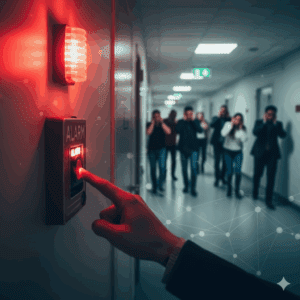
We all love a good fire drill…when it’s on the calendar.
Clipboards ready. Staff briefed. Someone even remembers to grab the fake fire extinguisher.
But what happens when the smoke detector goes off for real?
That’s where the unannounced drill earns its keep.
Predictable Doesn’t Prepare You
Let’s be honest…announced drills are comfortable.
Everyone knows it’s coming, so the response looks great on paper.
But in real life, emergencies don’t RSVP.
They don’t wait for your quarterly safety meeting or pick a day when all your key staff happen to be on shift.
Unannounced drills reveal what your system actually does when it’s not on stage:
- How quickly people recognize what’s happening.
- Whether communication flows naturally or stalls.
- If procedures hold up when stress levels rise.
It’s not about catching people off guard—it’s about catching process gaps before a real crisis does.
Simulation: Practicing for Reality
The CARF standards require organizations to conduct at least one unannounced test of each emergency procedure every year, on every shift, at every location.
That includes fires, bomb threats, natural disasters, utility failures, medical emergencies, and violent or threatening situations.
Each test must include a realistic or simulated response—ideally with a physical evacuation—so teams can experience what a true emergency would demand.
It’s not enough to say, “We’d know what to do.”
Drills must test how well your system functions under pressure, and whether those carefully written procedures actually translate into calm, coordinated action.
The best leaders treat these as live rehearsals:
“What would we do right now if…?”
That simple question—posed spontaneously, respectfully—builds readiness muscle without creating panic.
Safety Practice Without Panic
In behavioral health, long-term care, and medical rehabilitation, we have an added responsibility:
the people we serve may not interpret a drill as a drill.
Residents and patients with behavioral, cognitive, or physical challenges can experience real fear or confusion when alarms sound or lights flash.
That’s why drills must balance realism with empathy.
A few best practices:
- Prepare, but don’t pre-warn. Help individuals understand that drills happen to keep everyone safe.
- Use calm, clear language. Staff should model steady tone and reassurance.
- Include similar populations. Evacuation tests should reflect the true mix of individuals you serve—including mobility devices, support animals, or communication aids.
- Debrief afterward. Ask staff and residents what worked, what felt overwhelming, and what supports could help next time.
The goal is to make preparedness feel inclusive and empowering, not frightening.
From Performance to Preparedness
The CARF standards also remind organizations that procedures should promote safety, consider the unique needs of persons served, and include plans for evacuation, sheltering, and continuity of essential services.
That means drills must go beyond “everyone got out safely.” They should analyze:
- Which steps worked—and which didn’t.
- How staff communicated and accounted for everyone.
- Whether critical services could continue in an emergency.
- What needs to change before next time.
Real improvement happens when drills are documented, reviewed, and used to refine training, not just satisfy a requirement.
Culture Over Compliance
CARF doesn’t require every drill to be a surprise, but testing should reflect real-world conditions.
That’s a culture shift: from checking boxes to building capability.
Unannounced drills send a message that safety isn’t a scheduled performance; it’s a shared value.
They help leaders see how their systems respond when no one’s watching, and they help staff develop the confidence to act instinctively and safely.
The Bottom Line
Announced drills check a box.
Unannounced drills build resilience.
They turn policy into practice and practice into confidence—for staff and for the people you serve.
Because whether it’s a medical emergency, a storm, or something no one saw coming, safety isn’t about perfection.
It’s about readiness that respects reality.
At BRB Consulting, we help organizations design, test, and strengthen emergency procedures that work—on every shift, for every person.
Because preparedness isn’t paperwork.
It’s protection.